


York, England Our main focus today was the interior of the Minster, the crown jewel of York. It evolved from the city’s first church, which was built in 627.
We took a tour of the cathedral guided by a lovely gentleman who happened to have been an engineering draftsman. That meant that we learned more than we could possibly ever want to know about how the church had been built, renovated. enlarged and restored, with lots of engineering detail and humor. While we do know someone who would have eagerly eaten this information up, we mostly let the beauty of the building soak in.
There is more medieval glass here that in the rest of England’s churches combined. and it is astonishing.
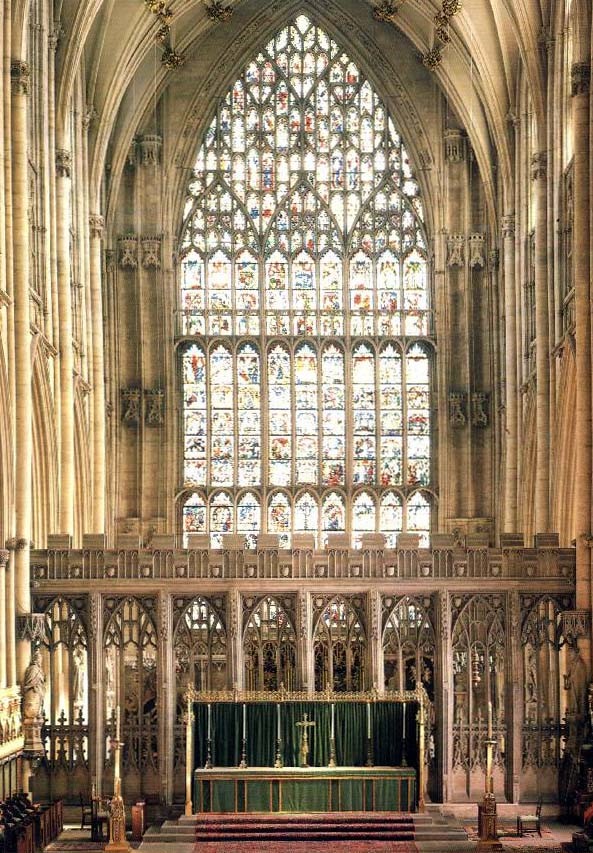


Despite various fires and the ravages of time, the interior looks pristine and every wall and column soars gracefully upwards — though sometimes things don’t quite line up perfectly.


The kings of England, starting with William the Conqueror, are tastefully represented, along with various important personages who merited burial in the Minster. Some locals only were represented as grotesques, giving the stone masons the chance to have a bit of fun.


In the undercroft museum, there are remains of the Roman fort upon part of which the Minster is built. The Romans were here in large numbers, and they also left their mark.


The crypt of the church contains the sarcophagus of Saint William, patron saint of York, born in the late 11th century. There are also several amazing artifacts of church history, such as the York Gospels, along with the baptismal font, which is still in use.


In the afternoon on this absolutely gorgeous day, we next went to the Museum of York, to focus on remnants of the Viking occupation of this part of the world. It did not disappoint, though you keep hoping a fabulous new horde will turn up soon. (And it may.) Nevertheless, there are some remarkable relics of those Viking adventurers who moved right in to Northumbria and made themselves at home.


The jewel of the collection is called the Coppergate Helmet, found buried in a well in 1982. It is not actually a Viking helmet, but an Anglo-Saxon artifact, likely buried for safekeeping just before the Viking Great Army arrived in 866 AD. It was preserved in spectacular condition. It is made of iron and copper alloy and features intricate animal designs on its nosepiece, and a Latin inscription on the crest.


Don’s Food Corner
We slipped into an Italian place to fortify ourselves before coping with the Vikings. Standard fare. Not bad. Pepperoni pizza for Jo. Spaghetti with Bolognese sauce for me. It started with a salad that supposedly featured Caesar dressing. I think all so-called Caesar dressing is really just Ranch. True in the U.S., true here.


A highlight of the meal was when I asked for a glass of tap water. The waitress returned with a big pitcher and two glasses filled to the brim with ice. She said, “I gave you a lot of ice because I know Americans like ice.” I approved. Later, when we were paying the bill, I told her that like many, if not most Americans, we had an ice maker built into our refrigerator and that a ice maker is nearly standard in new refrigerators. She rolled her eyes and said, “That’s crazy.” (They’ll come around. Thirty years ago you couldn’t even get a single ice cube in the UK. Now, it’s common. A few more years of global warming — aka the “biggest scam in world history” — and they’ll find the joys of ice and air conditioning.)
Earlier in the day we stopped at a little tea room for fortifications. Namely, cream tea. The scones were surprisingly good. They rivaled the scones we had yesterday at Betty’s. Nice dense buttery texture. I’ll give it an A. Things are looking up for scones in the north.

